Race day restrooms need a headcount, a course map and a delivery window that beats runner check-in. For a 500-runner 10K, plan on roughly 8 to 10 standard units plus at least one ADA unit at the start/finish, per OSHA 1926.51(c) ratios. Elk Grove Porta Pros builds the layout around your course, not the other way around.
Start with the field size, then split units between the start corral, the finish chute and any aid stations past mile three. OSHA 1926.51(c) sets construction-site ratios at one toilet per 20 workers, and race organizers in Elk Grove use the same math as a floor: one unit per 50 to 75 spectators or runners is a workable starting point for a timed event, adjusted up if the course loops back near the start. A standard unit runs about 44 by 48 inches on the ground and stands roughly 92 inches tall, so plan your placement zone with that footprint in mind, especially on narrow paths or levee trails. Every cluster needs an accessible option: ADA Standards section 213.2 requires at least 5 percent of clustered single-user units to be accessible, never fewer than one. If your race draws a crowd that lingers, like a post-race festival at the finish, add a few extra units rather than relying on runners to walk back to the start corral. Races with expo tents or beer gardens often add a deluxe flushable unit near VIP areas. Check the how many porta potties do I need guide for a longer breakdown by event type, and use the porta potty placement guide before you finalize your course map.
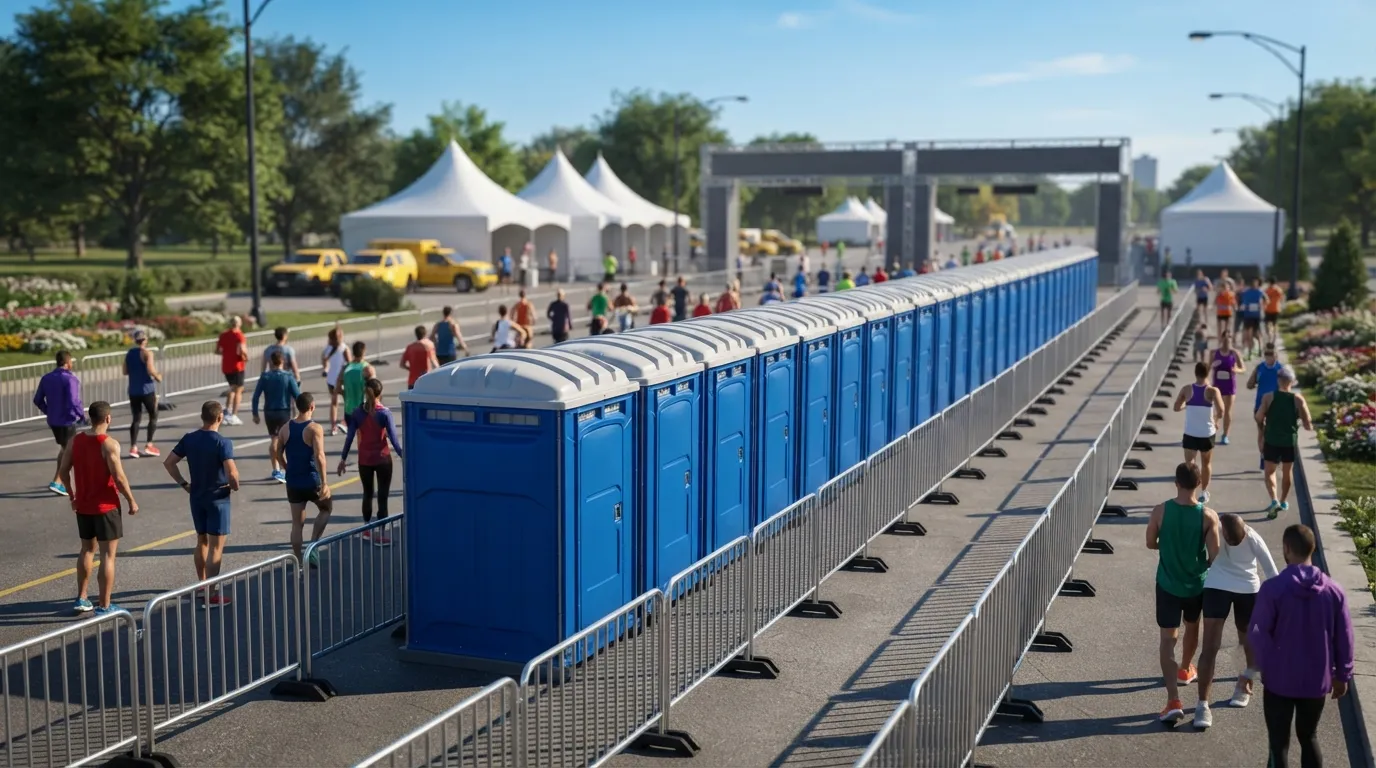
Place restrooms where runners already have to slow down: the start corral, mile markers with aid stations, and the finish chute. Ground has to be level and stable, since ADA Standards section 302.1 requires the surface under an accessible unit to be firm and slip resistant, and grass fields turn soft fast if there's been any rain. Leave 36 inches of clear approach per ADA Standards section 403.5.1, and remember the unit's own door needs at least 32 inches of clear opening per ADA Standards section 404.2.3. If your race uses generator-powered timing mats or a announcer's PA near the finish, you're likely also renting a temporary power pole; how to brace a temporary power pole matters here, because unbraced poles shift on soft turf and can pull a line loose mid-race. Stake guy-wires at three points minimum and check tension after the first hour of foot traffic, since crowds compact ground unevenly near a busy finish line. If you're running lights for a pre-dawn start, a light tower needs the same stable footing. For crowd flow at the finish, crowd control barrier or a short run of temporary fencing keeps spectators clear of the chute without blocking restroom access.
Delivery should land the afternoon before a morning race, giving your crew a full walk-through before runners arrive. Elk Grove courses that start before sunrise need units serviced and staged with enough clearance for the delivery truck, and a roll-off dumpster delivery alone needs about 60 feet of straight clearance behind the truck, so confirm your staging area isn't boxed in by barricades set up early. If your race route passes through areas near Florin, about 6.4 miles north, or loops toward Vineyard, 8.6 miles northeast, factor that drive time into your delivery schedule so units are locked in place before road closures start. Races that draw runners from Galt, 12.3 miles southeast, often see late parking overflow, which means extra restrooms near satellite lots pay off. Pair units with a handwashing station at food and hydration tables; 29 CFR 1910.141(d)(2) requires soap and towels or a hand-drying device at any handwashing setup, not sanitizer alone. For same-week bookings or a weather-driven date change, emergency porta potty rental covers the gap, and our event restroom page walks through timing for festivals, marathons and similar road events.
| unit | duration | typical price |
|---|---|---|
| standard | event | $400 |
| ada | weekend | $240 |
| trailer | event | $3,500 |
Pricing above reflects measured event-rate averages; a full breakdown lives on the porta potty rental cost page, and per-day numbers are on the porta potty rental per day page.
Book four to six weeks out for a race over 300 runners, since deluxe and trailer units book up during spring and fall race season in Elk Grove. Smaller fun runs can often be arranged with two weeks' notice.
Yes. ADA Standards section 213.2 applies to any cluster of single-user units, regardless of race size, requiring at least one accessible unit per cluster.
Units can be repositioned, but plan for it in advance. Moving a unit after a course is marked risks blocking a route or damaging turf; flag alternate spots during your walk-through instead.
Add units near vendor and beer garden areas separate from the finish chute cluster. A restroom trailer works well here if the festival runs several hours past the race itself.
Standard service follows a once-weekly baseline under ANSI/PSAI Z4.3, but single-day races typically only need one clean setup with a post-event pump-out and pickup.
Yes. Elk Grove Porta Pros delivers marathon and race restrooms across Elk Grove and the surrounding metro, with same-day and next-day drop-off available on most orders.
Pricing depends on the unit and how long you need it. See our cost breakdown and request a free quote for an exact figure.
Standard rentals include scheduled service — a pump-out, a clean, a restock and fresh deodorizer. Busy or hot-weather sites can be serviced more often.
Call now or request a free quote — clean units, on-time delivery, transparent pricing.